Best Smart Gadgets for Pets: Modern Tech Every Owner Needs
In recent years, the way we care for our pets has been transformed by technology. Whether you have a dog, a cat, or another beloved animal companion, smart gadgets for pets are making life easier for owners and healthier for animals. Indeed, from automated feeders to GPS trackers and health monitoring devices, the pet-tech market is booming. According to industry reports, AI-powered pet care gadgets now help with feeding, play, monitoring and even health diagnostics. In this article, we’ll explore the very best smart pet devices every owner should consider — especially if you want to combine convenience, safety, and enriched pet-care. We’ll also address how to choose the right gadget, what features matter, and how these technologies help your furry (or non-furry) friend thrive.PetPace +2Here’s what you’ll gain from reading this:A clear view of the different categories of smart pet gadgets (feeding, monitoring, safety, play)Insight into why each gadget matters for your pet’s welfare and your lifePractical buying tips: what to look out for (compatibility, battery life, subscription cost)Highlight of key low-competition keywords so you can do your own research easilyA forward-looking view of what’s next in pet tech
Let’s dive in.
Why Smart Pet Gadgets Are Worth It
Before jumping into individual gadgets, it’s important to understand why you might invest in them. Pet ownership comes with responsibilities — feeding, exercise, monitoring health, safety and social interaction. Smart gadgets help in several meaningful ways:
- Time savings & automation. If you’re busy, an automatic feeder or camera means you don’t have to rush home just to feed your pet. Similarly, a monitoring gadget keeps an eye on your pet while you’re away. For example, one article notes: “Smart feeders are solving the problem of ensuring pets are fed regularly and with the right amount of food.”
- Improved health & wellbeing. Devices like activity trackers and health monitors let you detect issues early (e.g., less activity, sleep changes). AI monitoring is increasingly used.
- Safety & peace of mind. GPS trackers, remote cameras, treat-launchers allow you to check in on your pet and ensure they are safe. One review lists GPS trackers as essential for dogs who might run off.
- Enrichment & engagement. Smart toys and interactive devices keep pets mentally stimulated — especially useful when you’re not home.
- Data-driven care. As more devices collect data (activity, feeding, sleep), you can make better decisions about your pet’s diet, routine and health.
Given these benefits, smart pet gadgets are not just “nice to have” — they are becoming an integral part of modern pet-care. The market reflects that: design and product innovation in pet tech is growing fast.
1. Smart Feeders & Drinkers
What they are
Smart feeders automate the process of feeding your pet — setting schedules, controlling portions, and sometimes even tracking feeding habits. Intelligent drinkers keep water fresh and monitor consumption.
Why they matter
- Pets kept alone for some hours benefit from consistent feeding times.
- Over- or under-feeding can lead to health issues; automation helps with accuracy.
- Some advanced ones integrate activity data to adjust portions.
- Water is often neglected; hydration matters especially in warm climates (like Pakistan).
What to look for
- Schedule & portion control.
- App / remote control.
- Food level sensor or alert.
- Compatibility with the pet’s size (small/large).
- Easy to clean.
- Reliable power source or battery backup.
- Support for multiple pets (if relevant).
2. Health & Activity Trackers
What they are
Devices worn by pets (collars, tags) that monitor activity level, sleep/rest patterns, sometimes heart rate/temperature. Some trackers also monitor location (GPS) and send alerts.
Why they matter
- Like fitness trackers for humans, they give insight into your pet’s lifestyle.
- Sudden drops in activity or changes in sleep might signal health concerns.
- For older pets or those with conditions, monitoring is especially beneficial.
- AI-powered trackers now analyse behavior and offer actionable insights.
What to look for
- Fit and comfort: collar or tag must suit your pet.
- Battery life.
- Data granularity (steps, rest, heart rate).
- Alerts/notifications for abnormal behavior.
- App support (IOS/Android).
- If location/GPS is included: accuracy, real-time updates.
3. Safety & Monitoring Devices (Cameras, GPS, Microchip Doors)
What they are
- Pet cameras allow you to watch, talk to and even treat your pet remotely.
- GPS locators for collars to track pets who roam.
- Smart doors for cats that use microchips to allow in/out, or virtual fencing.
- Environmental sensors (temperature, humidity) for pet spaces.
Why they matter
- Helps when you’re away from home: you can see and intervene if necessary.
- Location tracking prevents lost pets.
- Smart doors solve problems of stray animals or unwanted entry/exit.
- Environmental monitoring ensures your pet’s area is safe (e.g., not too hot/cold).
What to look for
- Camera resolution, two-way audio, treat dispenser (optional).
- GPS accuracy, geo-fencing, subscription fees.
- Smart door integration with pet’s microchip/collar tag.
- Alerts for motion, sound, or escape.
- Connectivity: WiFi reliability, app control.
4. Interactive Toys & Enrichment Gadgets
What they are
Automated or AI-powered toys that keep pets engaged. Examples: treat-launchers, laser-chase toys for cats, remote-controlled play devices, puzzle feeders.
Why they matter
- Mental stimulation = healthier, happier pets.
- Helps prevent destructive behaviors caused by boredom.
- Useful for indoor pets or when owner is busy/out.
What to look for
- Safety (no small detachable parts).
- Variety of modes/patterns of play.
- Remote control / app integration (optional).
- Easy to clean & durable.
- Battery life / charging convenience.
Top Smart Pet Gadgets Worth Considering
Here are some standout gadget types and what they deliver. While I won’t list specific brand-links (you can look them up easily), I’ll highlight features you should target.
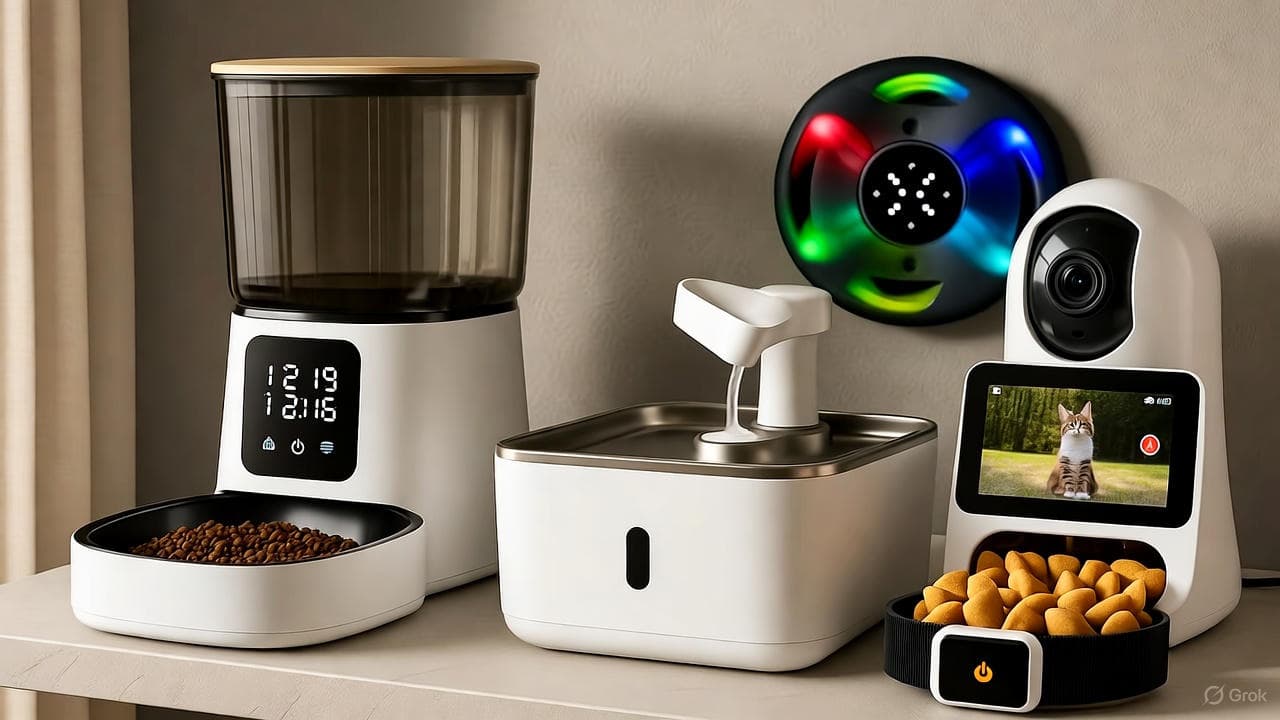
Smart Feeder Example
Consider a feeder that lets you preset meals, monitor food levels via app, and send notifications. For instance, some tech reviews mention that AI enabled feeders adjust portions automatically in response to the pet’s activity levels.
In practice: you could set breakfast at 7 am, lunch at 2 pm, dinner at 8 pm; if your pet skips lunch, you get an alert. Water dispenser adds hydration monitoring.
Activity/Health Tracker & Smart Collar
One leading tracker brands allow you to monitor steps, sleep, heart rate, and location. They often include real-time alerts when unusual behavior is detected. For example, companies like the one behind the tracker “Dog 6” emphasise health metrics plus geofencing.
When selecting: look for durable collar (for outdoor use), sufficient battery (several days), solid mobile app, and data you can act on (e.g., “Your dog’s rest time increased 25% this week”).
Pet Camera & Remote Interaction Device
For dogs with separation anxiety or indoor cats, a camera that allows you to watch and interact helps a lot. Some even have a treat-dispenser. For example, a review of a “dog camera lets you check up on your furry friend when you’re away from home, with HD video, two-way talk and motion-activated notifications.”
Important features: 360° view or wide lens, night vision (important for Pakistani homes as nights can be long), remote treat toss, alert when pet is barking or misbehaving.
GPS / Smart Door / Virtual Fence
For outdoor roaming pets, or cats who might sneak out, a GPS collar with geo-fencing is very useful. For instance, a tracker that supports virtual fences, alerts when pet leaves the zone, and shows real-time location.
Alternatively, a smart pet door that reads your cat’s microchip and only allows entry/exit for your pet, preventing stray animals from entering.
Interactive Toy / Enrichment Device
When you’re busy, your pet still needs mental stimulation. An interactive gadget such as a treat-launcher or laser toy for cats will help. For busy owners, “interactive AI-powered toys are designed to keep pets engaged even when owners are busy.”
Look for: multiple modes (randomised play), safe materials, remote control or schedule, treat integration.
Health Monitoring Systems (Advanced)
For pets with medical conditions or older pets, there are health-monitoring platforms that include sensors for weight, litter habits (for cats), and even microbiome testing. Example: the company “Petivity” offers a smart litter box monitor to track weight & urination/defecation patterns.
This kind of gadget may be more niche, but for some owners it’s worth the investment.
How to Choose the Right Smart Pet Gadget (For You)
With so many gadgets on the market, how do you pick the right one? Here are key considerations and questions:
1. Compatibility & Connectivity
- Does it require WiFi, Bluetooth, or mobile network? Ensure compatibility with your home setup (in Abbottabad, check your WiFi strength).
- Is there an app? Are updates frequent?
- Does it support your pet’s size/type (small dog vs large dog vs cat)?
- Is the device region-locked (some chargers/plugs not suited for Pakistan)?
2. Power & Battery Life
- Battery life matters: you don’t want to recharge every few hours.
- For outdoor GPS collars: how long does it last? Is there a subscription fee?
- For indoor devices: is there a backup power option in case of electricity outages?
3. Data & Subscription Costs
- Some “smart” devices require monthly subscription fees (for GPS tracking, advanced analytics).
- Check what is included: free firmware updates? Data storage?
- For budget owners, a one-time cost device may be preferable.
4. Ease of Use & Cleaning
- Especially for feeders & drinkers: how easy is it to clean (important in humid climates)?
- For pet toys: are the parts durable? Are spare parts available locally?
- User interface: is the app simple and reliable?
5. Local Support & Repair
- Is the brand available in your country/region? Are spare parts accessible in Pakistan?
- Is customer support international?
- Consider return policy, warranty, shipping time/cost.
6. Real Need & ROI
- Do you really need it? For example:
- If you’re home most of the time, maybe you don’t need the remote camera/treat-tossing gadget.
- If your pet never goes outdoors, a GPS collar may be less valuable.
- Think: will the gadget actually improve your pet’s life or just be a novelty?
7. Future Proofing
- Choose devices that get firmware updates, are compatible with new standards, and integrate future features (AI insights, health analytics).
- Considering how pet tech is evolving rapidly (see below), select brands that are staying current.
Trends & What’s Next in Pet Tech
To stay ahead of the curve, consider the emerging trends in pet gadgets.
- AI-powered insights: As noted, AI isn’t just a buzzword — devices now analyse behavior patterns, health metrics and give actionable alerts.
- Integrated ecosystems: The future will see devices speaking to each other — e.g., activity tracker tells feeder how much food to give; smart bowl communicates with health tracker.
- Advanced health diagnostics: Devices like litter box monitors track weight & urination for cats; wearable sensors track heart rate/oxygen for dogs.
- Virtual fencing & global tracking: GPS collars with global network support let pets roam wide, yet stay tracked.
- More affordable devices: As tech matures and competition rises, smart pet gadgets will become more price-accessible.
- Localized smart pet care: In countries like Pakistan, devices will adapt to local market needs (higher temperature tolerance, regional network support, local service).
- Sustainability & safety: Safe materials, energy efficiency and pet-friendly design will be emphasised more.
Pros & Cons of Smart Pet Gadgets
Every technology has pros and cons. Let’s be balanced.
Pros
- Enhanced peace of mind: you can monitor your pet remotely.
- Healthier pets: better feeding control, activity tracking, early detection of issues.
- Enrichment: interactive play gadgets reduce boredom, destruction.
- Safety: GPS tracking, geofences ensure pets don’t get lost.
- Time-saving: automation means fewer things to worry about when you’re busy or travelling.
Cons
- Cost: initial purchase + possible subscription fees.
- Overdependence: gadgets are helpful, but don’t replace love, training, human-pet interaction.
- Tech issues: connectivity problems, battery failures, app glitches.
- Data overload: too many alerts may cause anxiety rather than calm.
- Compatibility/repair issues in regions where service/support is limited.
So, while smart pet gadgets offer many benefits, they should complement — not replace — good pet care practices, training, and human attention.
Putting It All Together: A Sample Buying Guide for Pet Owners
Here is a step-by-step mini checklist you can follow when buying one or more smart gadgets for your pet:
- Define your need: Are you often away from home? Is your pet overweight or inactive? Does your pet roam outdoors?
- Set a budget: Consider initial cost + any monthly fees.
- Check compatibility: WiFi strength, smartphone app availability, power outlets in your home location (Abbottabad), support for your region.
- Pick one gadget category first: If you have to start somewhere, choose what impacts your pet most (feeding vs safety vs health).
- Read reviews & user experiences: Look for failures, battery life, real-world usage. Sources like “Top 10 dog gadgets” have good insights.
- Consider scalability: If you plan more pets or more devices in the future.
- Install & test properly: Set up zone alerts, notifications, schedules. Check that your pet uses it and you understand the interface.
- Monitor results: After a month, evaluate: Are you getting fewer feeding issues? Is your pet more active? Are you less worried when away?
- Adjust/user feedback: Some pet gadgets have learning curves; give your pet time to adapt (especially cameras, toys).
- Reassess annually: As you upgrade your home, network, or your pet ages, you may need different gadgets.
Common Mistakes to Avoid
- Buying based on brand only: Big name doesn’t always mean best for your situation.
- Ignoring region & power specifics: For example, appliances might be rated for 120 V, but Pakistan uses 220-240 V (so check adaptor/plug).
- Choosing gadgets that your pet hates: E.g., collars that are too heavy, feeders your pet won’t approach.
- Ignoring data/privacy: Some devices store your pet’s activity data in cloud; check security and subscription terms.
- Letting the gadget replace human interaction: A smart toy can help, but playing with your pet yourself is still irreplaceable.
- Not updating firmware / ignoring alerts: Tech fails if you ignore updates or alerts about battery/warning signs.
Scenario Use-Cases
Let’s walk through a few hypothetical but practical scenarios to see how smart pet gadgets can help.
Scenario A: Working Professional with a Dog
You’re out all day at work, from 9 am to 6 pm. Your dog is at home, maybe bored.
- Install a smart feeder to deliver a midday meal and track whether your dog eats.
- Use a pet camera with two-way audio so you can check in and comfort your dog if anxious.
- A toy launcher can keep your dog active at home.
- Outcome: less separation anxiety, less guilt, better routine.
Scenario B: Outdoor Cat Who Roams
Your cat likes exploring the neighbourhood and sometimes strays.
- Use a GPS tracker collar with geo-fencing: receive alert if cat leaves the zone.
- Use a smart pet door that only opens for your cat (via microchip) to keep out strays.
- Use an activity monitor to check if your cat is sleeping more than usual (could signal illness).
- Outcome: safer outdoor time, better monitoring of cat’s health and activity.
Scenario C: Senior Pet with Health Issues
Your pet is older and has reduced activity or chronic health concerns.
- Use a health tracker collar to monitor movement, rest, heart rate.
- Use a monitoring gadget (like litter box sensor for cats) that tracks weight, toilet habits.
- Use a smart feeder with health-oriented food and portion control.
- Outcome: early detection of health issues, data to share with the vet, improved quality of life.
What to Expect in Terms of Investment
Here’s a rough guideline of what you might expect to invest in smart pet gadgets, keeping regional adjustments (Pakistan) in mind:
- Smart feeder (basic): moderate cost; advanced features (app control, scheduling) higher.
- Activity/health tracker collar: various tiers; basic step tracking cheaper, heart-rate/GPS tracking costlier.
- Pet camera: mid-range; treat-launcher or 360° high-end add-ons increase cost.
- GPS tracker: initial hardware + possible monthly subscription (for mobile data).
- Interactive toy: relatively affordable, but brand/power features vary.
- Advanced health monitoring (smart litter box, full microbiome kit): premium segment.
When buying in Pakistan, consider import tariffs, shipping, warranty/supplier support. Sometimes local distributors will be more convenient for servicing.
Summary & Final Thoughts
To summarise: modern pet ownership is evolving. Smart pet gadgets are no longer gimmicks; they deliver real benefits: better feeding, improved health monitoring, enhanced safety, and more enrichment for your pet.
If you adopt them wisely — matching gadget to your pet’s needs, checking compatibility and cost, and using the data they provide — you’ll enhance both your life and your pet’s welfare.
In other words: technology + compassion = best results.
Moreover, as pet-tech advances with AI, integrated ecosystems and health-focused monitoring, the value you get from investing in smart gadgets will only grow.
So whether you’re a busy working‐owner, have a senior pet, or simply want to upgrade your pet care game — exploring the right smart gadgets is a worthwhile step.