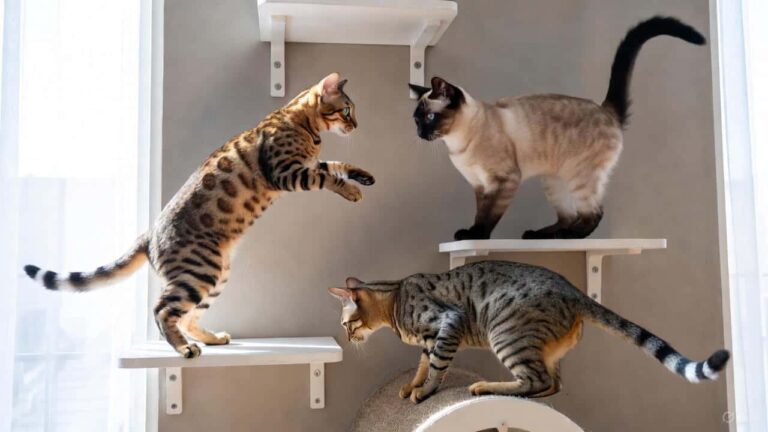

15 ! The Science of Cat Communication Made Simple.
How well do you understand your cat? Learn the science behind feline emotions, communication signals, and why the bond with cats feels so deep — even in grief.in this guide we will lern
- Introduction:
- The Mystery of the Cat-Human Bond
- Why Understanding Your Cat Matters
- The Science Behind “Speaking Cat”: How Researchers Measure Understanding
- Cat Vocalizations: What Every Sound Really Means
- Cat Body Language: Tail, Eyes, Ears & Whiskers
- Emotional Signals Cats Use to Communicate
- Why Humans Misunderstand Cats
- Building a Stronger Bond With Your Cat
- When the Bond Breaks: The Deep Grief of Losing a Pet
- Why Society Minimizes Pet Loss
- The Psychology of Pet Attachment
- The Science of Pet Grief
- Emotional Stages of Feline Loss
- Healing After Losing a Cat
- Meaningful Ways to Honor Your Cat’s Memory
- Key Takeaway Box
- Frequently Asked Questions (FAQ)
1.The Mystery of the Cat-Human Bond
Cats have lived alongside humans for thousands of years. Yet even today, they remain mysterious, gentle, selective, and intriguingly expressive. While dogs openly show affection, cats communicate in a more refined, subtle, and emotional language.
Interestingly, most cat owners believe they understand their pets — but modern scientific studies reveal the opposite. Researchers found that many people misunderstand more than half of the signals cats give, even when they believe they’re doing everything right.
This is why the connection between humans and cats is both beautiful and fragile. And understanding a cat’s emotional world is essential — especially when we later face the painful grief of losing them.
2. Why Understanding Your Cat Matters
Knowing how your cat communicates helps you:
✔ Strengthen trust
✔ Prevent stress or aggression
✔ Understand emotional needs
✔ Reduce anxiety
✔ Improve bonding
✔ Create a safe, loving home environment
Cats rely on body language more than words. When we fail to read them, misunderstandings grow — and emotional distance follows.
Moreover, the deeper the bond you build while they’re alive, the more powerful and meaningful their memory becomes after they’re gone.
3. The Science Behind “Speaking Cat”: How Researchers Measure Understanding
Recently, scientists developed a quiz that measures how well humans understand cats. This quiz:
- Uses real cat videos
- Tests facial expressions
- Evaluates body language interpretation
- Plays audio clips of cat vocalizations
- Presents emotional scenarios
Most participants score low — around 40% accuracy.
Surprisingly, even lifelong cat owners sometimes struggle. This proves that cat communication is far more complex than we assume.
Focus Keywords Used:
- understand your cat
- cat communication quiz
- feline behavior science
4. Cat Vocalizations: What Every Sound Really Means
Cats have dozens of vocal expressions. Some are loud and obvious, while others are so subtle that many people ignore them.
Meowing
Cats rarely meow at each other.
They meow for humans.
Different meows mean:
- Short, high-pitched: greeting
- Continuous meowing: attention seeking
- Mid-pitch: asking for food
- Low-pitch: complaint
- Loud yowling: distress or mating behavior
Purring
Most people assume purring means happiness.
But purring can also mean:
- Pain
- Stress
- Self-soothing
- Seeking comfort
Chirping & Trilling
These soft, adorable sounds usually mean:
- Excitement
- Playfulness
- Friendly greeting
Hissing or Growling
Clear signs of:
- Fear
- Warning
- Aggression
5. Cat Body Language: Tail, Eyes, Ears & Whiskers
If you truly want to “speak cat,” body language is the most important area to master.
Tail Signals
- Tail Up: friendly, confident
- Tail Slowly Swishing: irritated
- Tail Puffed: fear or excitement
- Tail Tucked: anxiety
Eye Signals
- Slow blink: trust
- Wide eyes: fear or curiosity
- Half-closed: relaxed
Ear Signals
- Forward: alert
- Sideways: overwhelmed
- Flattened: defensive
Whiskers
- Forward: focused or hunting
- Neutral: calm
- Pulled back: scared
6. Emotional Signals Cats Use to Communicate
Cats express emotions in delicate, sophisticated ways:
Kneading
Shows comfort, love, or bonding.
Head-Butting
A sign of affection and scent marking.
Grooming Your Hair
They’re treating you like family.
Sleeping Near You
Deep trust and attachment.
Bringing You ‘Gifts’
A sign of respect — as strange as it feels.
7. Why Humans Misunderstand Cats
Here’s why most people fail to read cat communication correctly:
- Cats are subtle compared to dogs
- People assume all pets behave the same
- Humans don’t notice tiny body signals
- Cultural myths about cats cause confusion
- Many owners misinterpret tail or eye cues
One of the biggest misunderstandings is the belly display.
People think it means:
“Rub my belly!”
But most cats display their belly to show trust — NOT for touch.
8. Building a Stronger Bond With Your Cat
If you want to improve your communication:
Slow blink at your cat
It’s a universal sign of affection.
Respect boundaries
Stop petting when the tail twitches.
Use positive reinforcement
Cats respond to gentle encouragement.
Talk softly
Cats prefer calm tones.
Give choices
Cats love environmental control.
Maintain routines
Predictability reduces stress.
: Related:👉
How to Bond With a New Cat
9. When the Bond Breaks: The Deep Grief of Losing a Pet
Here the two topics combine beautifully.
The stronger your bond with a cat, the deeper the pain when they’re gone.
Many pet owners describe the loss as:
- Losing a child
- Losing a best friend
- Losing emotional support
- Losing a piece of themselves
Yet society often responds with statements like:
“It was only a cat.”
“You’ll get another one.”
“At least it wasn’t a person.”
These statements minimize real emotional pain.
This is why the quote hurts so much:
“When you lose a pet, the world sees it like you’ve lost maybe a quarter of a human.”
But to you, it feels like losing family — because it is.
10. Why Society Minimizes Pet Loss
Reasons include:
- Not everyone has experienced deep pet bonds
- Cultural beliefs that humans matter more
- Generational views that animals are “just pets”
- Lack of emotional awareness
But modern psychology strongly disagrees.
11. The Psychology of Pet Attachment
Psychologists call the cat-human bond a secure attachment, similar to:
- parent-child connection
- friendship bonds
- emotional dependence
Cats offer:
✔ Non-judgmental love
✔ Emotional stability
✔ Comfort during loneliness
✔ Routines and structure
✔ Companionship
This is why losing them shatters emotional foundations.
Focus Keywords Used:
- psychology of pet attachment
- emotional bond with pets
12. The Science of Pet Grief
Here’s what researchers discovered:
- The human brain reacts to pet loss the same way it reacts to human loss.
- Stress hormones spike sharply after a pet dies.
- Emotional shock can last for weeks or months.
- People deeply attached to their cats often experience long-term sadness.
Pet loss is real grief, not exaggerated emotion.
13. Emotional Stages of Feline Loss
Just like human grief, pet grief has stages:
- Shock
- Guilt
- Anger
- Sadness
- Acceptance
There is no “right” timeline.
Everyone heals differently.
14. Healing After Losing a Cat
Here are healthy ways to cope:
Allow yourself to grieve
Don’t suppress emotions.
Talk about your cat
Memories help healing.
Create a memorial
Photos, candles, letters — all meaningful.
Don’t blame yourself
You did your best.
Connect with others
Pet loss communities provide comfort.
External Resources:
https://www.vet.cornell.edu/about-us/outreach/pet-loss-support-hotline
Helpful Resources:
https://www.aspca.org/helping-people-pets/pet-loss
15. Meaningful Ways to Honor Your Cat’s Memory
Try:
- Planting a tree
- Creating a memory shelf
- Framing your favorite photo
- Keeping their collar
- Writing a letter
- Making a memorial stone
IAlso Read:👉
Cat Training Guide
16. KEY TAKEAWAY SECTION
KEY TAKEAWAY:
Cats express love, trust, fear, and emotion through subtle signals. Understanding their language strengthens your bond — and makes their loss even more meaningful. Pet grief is real, powerful, and deeply human. You are allowed to mourn, remember, and heal at your own pace.
17. Frequently Asked Questions (FAQ)
Q1. Why do cats communicate so subtly?
Because they evolved as both predators and prey — subtlety kept them safe.
Q2. Why does losing a cat hurt so much?
The emotional attachment functions like human bonding, triggering deep grief.
Q3. Do cats understand our emotions?
Yes. Studies show cats detect tone, sadness, routine changes, and emotional energy.
Q4. How can I improve communication with my cat?
Use slow blinking, respect boundaries, observe body language, and maintain routines.
Q5. Is it normal to cry over a pet?
Absolutely. Crying is healthy and natural during grief.
Q6. Should I immediately adopt another pet?
Only when your heart feels ready. There is no correct timeline.