What Is Bird Anting? The Fascinating Natural Medicine Birds Use
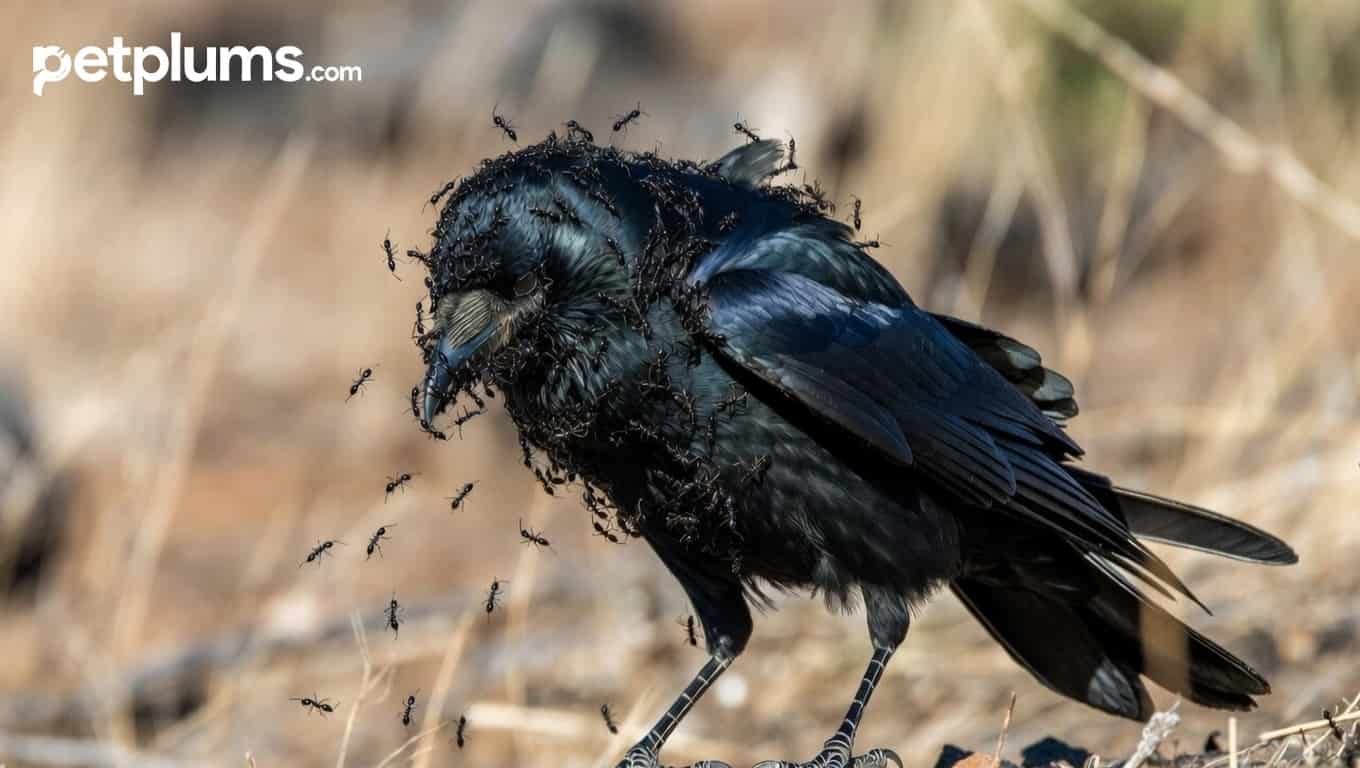
Bird Anting behavior: This vulnerable crow stands still as ants crawl over it, using formic acid to fight parasites naturally. Stunning wildlife moment!
Have you ever stumbled upon a scene in nature that makes you pause and wonder about the hidden intelligence of animals? Picture this: a crow, usually so sharp and cunning, suddenly perches near an anthill, spreads its wings, and lets a horde of ants swarm all over its body. It doesn’t flee or fight; instead, it seems to embrace the chaos. This isn’t some random act of desperation—it’s a deliberate strategy rooted deep in the bird’s instincts. When a crow feels sick, weak, or uncomfortable, it adopts a very surprising and wise method found in nature. It doesn’t go in search of prey or try to escape from an enemy, but rather it turns to an anthill. This action isn’t for hunting, but for healing.
The crow sits on the anthill with its wings spread and shakes its body for a while, then becomes still in one place. During this time, ants crawl over its wings and body. The ants secrete a special chemical called formic acid, a powerful natural disinfectant that helps kill bacteria, insects, lice, and other harmful germs. This process is scientifically known as “bird anting behavior,” and it’s a natural remedy passed down from generation to generation in birds. The crow knows exactly what it’s doing—it uses the ants’ defense system as its own personal pharmacy.
Some crows take this process a step further, picking up ants with their beaks and rubbing them on specific feathers, much like a human applying ointment or medicine to a targeted area. This is a wonderful example of how nature equips animals to heal themselves using available resources, without needing a doctor or synthetic drugs. In this comprehensive guide, we’ll dive deep into the world of bird anting behavior, exploring its mechanics, purposes, and fascinating examples across species. Whether you’re a bird enthusiast, a nature lover, or just curious about animal habits, this exploration will reveal how birds like crows turn everyday insects into lifesavers. Moreover, we’ll touch on related concepts like natural parasite control in birds and crow intelligence, shedding light on why this behavior captivates scientists and observers alike.
What Exactly Is Bird Anting Behavior?
To start, let’s break down what bird anting behavior truly entails. At its core, it’s a maintenance routine where birds intentionally interact with ants or similar insects to rub them against their feathers and skin. This isn’t accidental—birds seek out these encounters. For instance, a bird might spot an active anthill and decide it’s the perfect spot for a “spa session.” The term “anting” comes from observations dating back centuries, but it gained scientific traction in the mid-20th century when ornithologists began documenting it systematically.
Bird anting behavior falls into two main categories: active and passive. In active anting, the bird takes charge. It picks up an ant (or a few) in its beak, crushes it slightly to release the juices, and then methodically wipes it across its plumage. This can look like intense preening, but it’s far more purposeful. Passive anting, on the other hand, is more laid-back. The bird simply lies down on or near the anthill, spreads its wings and tail, and allows the ants to climb aboard. The ants, feeling threatened, release their defensive secretions as they scurry through the feathers.
Why ants specifically? Well, not all ants are used—birds tend to prefer those from certain subfamilies that produce formic acid, a compound with potent antimicrobial properties. This acid acts like a natural insecticide, targeting parasites that plague birds. However, birds don’t limit themselves to ants; they’ve been seen using millipedes, snails, or even non-insect substitutes like cigarette butts or citrus peels when ants aren’t available. This adaptability highlights the ingenuity in bird self-care routines.
Transitioning to the broader picture, bird anting behavior isn’t just a quirky habit—it’s widespread. Over 200 species of birds, mostly songbirds or passerines, have been recorded engaging in it. From common backyard visitors like blue jays and robins to more exotic ones like starlings and waxwings, this behavior crosses continents and ecosystems. In fact, it’s been observed everywhere except Antarctica, showing how universal this natural parasite control in birds truly is.
RELATED

The Evolutionary Roots of Anting: Why Did It Develop?
Now, let’s delve into the “why” behind bird anting behavior. Evolution doesn’t favor pointless actions; everything has a purpose, even if it’s debated among experts. One leading theory is that anting serves as a defense against ectoparasites—those pesky mites, lice, and fleas that infest feathers and skin. Formic acid from ants irritates and kills these invaders, providing relief and preventing infections. Imagine it as birds using ants like we use bug spray, but in a more eco-friendly way.
However, that’s not the only explanation. Some researchers suggest anting helps with feather grooming. During molting seasons, when birds shed old feathers and grow new ones, their skin can get itchy and irritated. The acid might soothe this discomfort, much like applying aloe to a sunburn. Additionally, there’s the food preparation hypothesis: by rubbing ants on their bodies, birds could be neutralizing the ants’ bitter taste, making them easier to eat afterward. This ties into crow intelligence, as these birds are known for tool use and problem-solving.
In addition, anting might offer sensory stimulation. Birds, like humans, could derive a sort of “pleasure” from the tingling sensation of the acid, similar to how we enjoy a spicy meal. This self-stimulation idea, though less popular, adds a layer of intrigue. For example, in controlled studies, birds exposed to ant substitutes showed similar enthusiasm, suggesting it’s not just about the ants but the overall experience.
To illustrate, consider the historical context. Anting was first noted in the 1800s by naturalists like John James Audubon, who saw turkeys wallowing in anthills. Over time, as microscopy advanced, scientists linked formic acid to parasite control. Today, with modern ecology, we see how this behavior fits into larger ecosystems, where birds and ants coexist in a delicate balance. This evolutionary adaptation underscores nature’s efficiency—birds turn potential pests into allies.
Types of Anting: Active vs. Passive Explored
Building on that, let’s examine the two types of bird anting behavior in more detail. Active anting is the more dynamic form. Here, the bird acts like a pharmacist, selecting specific ants and applying them precisely. A crow, for instance, might grab an ant, squeeze it gently to release the acid, and then stroke it under its wings or along its tail feathers. This targeted approach is common in species like blue jays, which have been filmed in slow motion performing this ritual.
On the contrary, passive anting is more opportunistic. The bird finds a bustling anthill, positions itself to provoke the ants, and lets nature take its course. It might flutter its wings to stir up the colony, encouraging the ants to swarm. This method is often seen in larger birds like turkeys or grouse, who can cover more ground. Interestingly, passive anting can last longer—up to 30 minutes—allowing thorough coverage.
For example, in crow behavior specifically, both types are observed. Crows, being highly intelligent, often combine anting with other activities, like bathing or sunning, for a full self-care regimen. This versatility makes them prime subjects for study. Moreover, in urban areas, crows adapt by using human litter as ant substitutes, showing their resilience.
Transitioning smoothly, what about the risks? While beneficial, anting isn’t foolproof. If a bird chooses stinging ants, it could end up irritated rather than healed. That’s why species selectivity is key—birds instinctively pick non-stinging, acid-producing ants.
Scientific Studies and Observations on Anting
Shifting gears, let’s look at the science backing bird anting behavior. Numerous studies have illuminated this phenomenon. For instance, a 1957 paper by Kelvin Simmons reviewed over 200 cases, categorizing behaviors and hypothesizing functions. More recently, research from the Cornell Lab of Ornithology has used citizen science data to map anting occurrences, revealing patterns tied to migration and breeding seasons.
One pivotal study from the 1990s tested the parasite control theory. Researchers infested captive birds with lice and observed increased anting when ants were provided. The results? Parasite loads dropped significantly post-anting, thanks to formic acid’s miticidal effects. This supports natural parasite control in birds as a primary driver.
Furthermore, field observations add color. In Montana, a naturalist watched a robin engage in passive anting, noting how the bird seemed revitalized afterward. Similar anecdotes from Reddit and bird forums describe blue jays stumbling during intense sessions, almost like they’re in a trance.
However, debates persist. A 2004 study suggested anting might prepare ants for consumption by removing defensive chemicals, challenging the grooming hypothesis. This food-prep angle is intriguing, especially for omnivorous crows.
In terms of crow intelligence, experiments show they learn anting from peers, passing it generationally. This social learning elevates anting from instinct to culture, much like tool use in primates.
Examples of Anting Across Bird Species
To expand our understanding, bird anting behavior isn’t exclusive to crows—it’s a shared trait among many. Take blue jays: these bold birds are anting superstars, often seen in backyards rubbing ants on their vibrant feathers. Their active style is flashy, with wings fanned and tails twisted.
Similarly, robins employ passive anting, lying prostrate on anthills during summer. This helps them combat mites from nesting. Waxwings, with their silky plumage, use fruit juices as substitutes, blending anting with anointing.
On a global scale, European starlings ant in flocks, turning it into a communal event. In Africa, certain weavers use millipedes, adapting to local fauna. Even owls and flickers have been spotted anting, though rarely.
Focusing on crows, their anting is particularly strategic. American crows in urban parks seek out fire ant hills (carefully avoiding stings), while ravens in deserts use desert ants. This adaptability ties into crow behavior studies, where anting correlates with health and survival rates.
For instance, a YouTube video captured a crow in slow motion, showing ants crawling en masse— a vivid reminder of nature’s raw side.
RELATED

Benefits and Potential Drawbacks of Anting
With that in mind, the benefits of bird anting behavior are clear. Primarily, it’s an effective natural parasite control in birds, reducing ectoparasite burdens without energy-intensive scratching. This saves time for foraging and mating.
Additionally, anting promotes feather health. Formic acid softens old quills, easing molting. It may also enhance waterproofing, crucial for flight.
Psychologically, it could reduce stress—birds post-anting appear calmer, perhaps from endorphin-like effects.
Nevertheless, drawbacks exist. Over-anting might damage skin if acid is too concentrated. In rare cases, birds ingest toxic ants, leading to illness. Urban pollution can contaminate substitutes, posing risks.
Overall, the pros outweigh cons, making anting a net positive in avian evolution.
Similar Behaviors: Sunning, Dusting, and Anointing
Comparatively, bird anting behavior fits into a suite of self-maintenance habits. Sunning, where birds bask with wings spread, uses UV light to kill parasites and synthesize vitamin D. Like anting, it’s passive and therapeutic.
Dusting involves rolling in dry soil to absorb oils and dislodge pests— a gritty alternative to acid.
Anointing extends anting, using plants or insects for similar effects. For example, some birds rub citrus on feathers for antifungal properties.
These behaviors highlight birds’ resourcefulness, turning environments into toolkits.
The Role of Anting in Ecosystems and Conservation
Broadening the scope, bird anting behavior influences ecosystems. By controlling parasites, it maintains bird populations, which regulate insects and seeds. Ants benefit too, as disturbed colonies disperse, aiding genetic diversity.
In conservation, understanding anting helps assess habitat health. Declining ant populations from pesticides could disrupt this behavior, impacting birds.
For birdwatchers, spotting anting is a thrill—contribute to apps like eBird to aid research.
Human Parallels and Lessons from Nature
Interestingly, humans echo anting in herbal remedies. We use essential oils for skin care, much like birds use formic acid.
This teaches sustainability: nature’s solutions are efficient and waste-free. As climate changes, studying crow intelligence and adaptations like anting could inspire eco-innovations.
Frequently Asked Questions About Bird Anting
Bird anting is a fascinating behavior in which birds deliberately allow ants to crawl over their feathers or rub crushed ants onto their plumage. This natural process helps birds control parasites and maintain feather health using formic acid produced by ants.
Birds perform anting primarily to kill or repel ectoparasites like mites, lice, and fleas. The formic acid released by ants acts as a natural insecticide and disinfectant for their feathers and skin.
Over 200 bird species are known to ant, especially songbirds (passerines). Common examples include crows, blue jays, robins, starlings, grackles, waxwings, and even some game birds like wild turkeys.
There are two types: passive anting (bird sits on anthill and lets ants crawl over it) and active anting (bird picks up ants and rubs them directly on feathers).
Yes! Crows are among the most well-known birds that perform anting. When feeling sick or uncomfortable, many crows seek out anthills as a natural way to disinfect and remove parasites.
Most ants used in anting (especially formicine ants) release formic acid, a powerful natural antimicrobial and insecticide that helps birds get rid of harmful parasites.
Conclusion: Embracing the Wonder of Bird Anting
In summary, bird anting behavior is a testament to nature’s ingenuity. From crows turning anthills into pharmacies to global species adopting this ritual, it’s a blend of instinct and intelligence. While debates on its exact purpose continue, the evidence points to parasite control, grooming, and more.
Next time you see a bird acting oddly near ants, pause and appreciate this ancient practice. It’s a reminder that even small creatures hold big secrets.
For more on this topic, check out the Wikipedia page on anting: Anting (behavior).